

This week on Weekly Tips, it's the V5 Smart Motor's turn on stage!
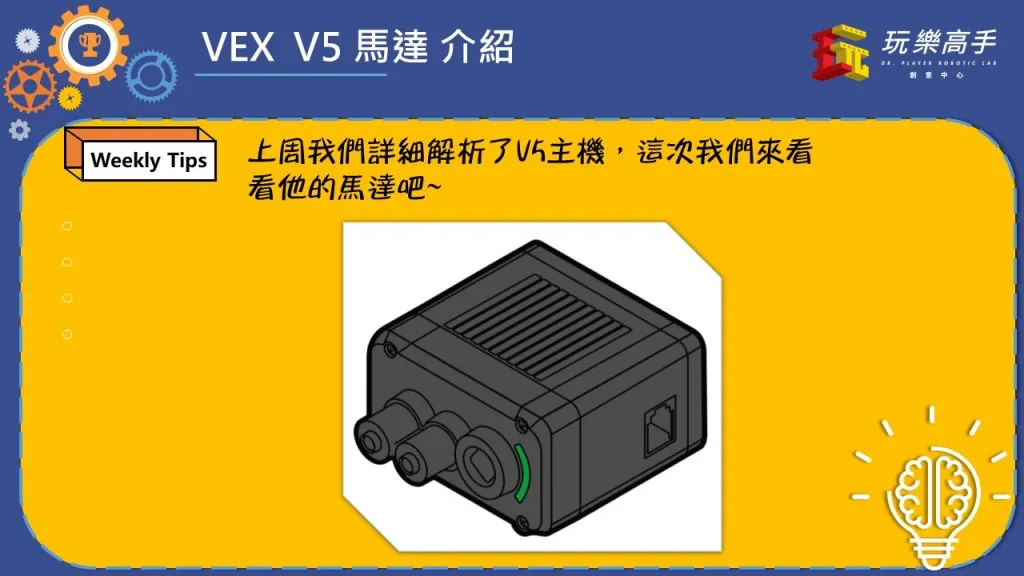
The motor is one of the most important parts of a robot. Let's take a look at the only motor in the VEX V5 kit!
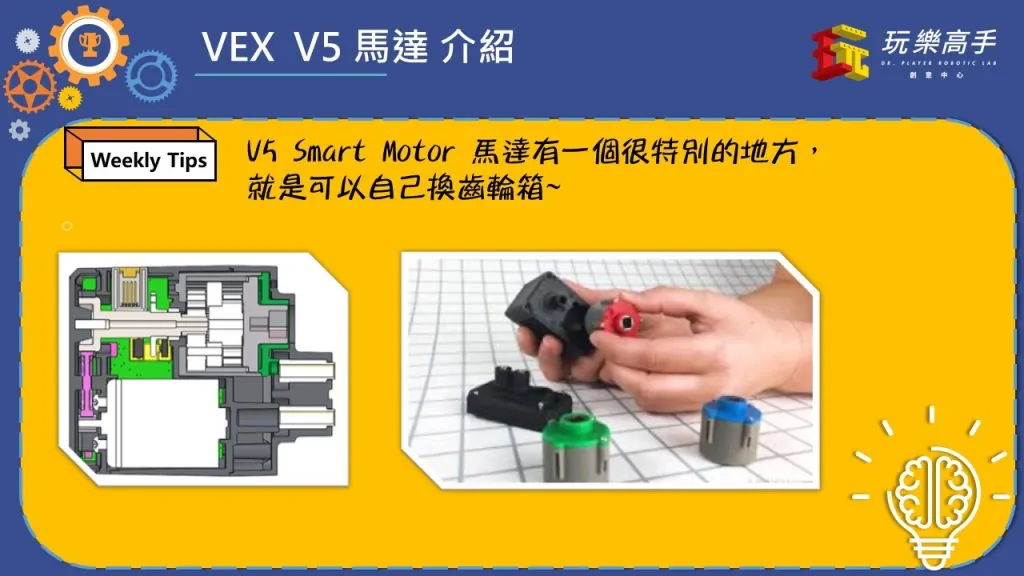
What sets the VEX V5 Smart Motor apart from other motors is that you can swap its “gearbox”! You don't need to buy a different motor for a specific need.
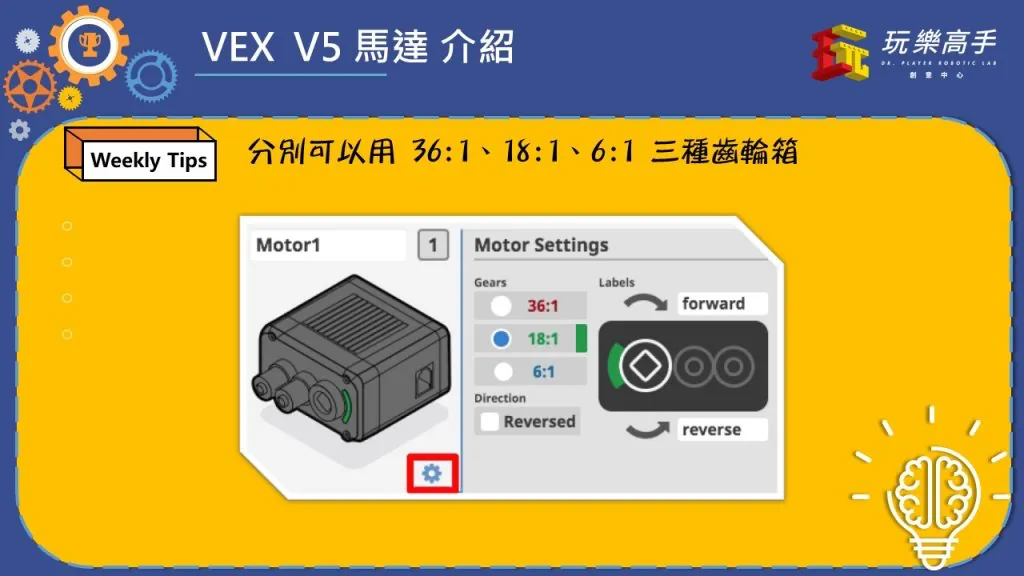
It offers “planetary” gearboxes in three ratios, 36:1, 18:1, and 6:1, which you can swap as needed. For example, a drivetrain that needs to run fast calls for 6:1, while a motor lifting heavy loads calls for 36:1. VEX ships every motor with an 18:1 gearbox by default, and you can buy others yourself if you want to swap.
V5 shafts actually come in thin and thick versions, and the V5 connector is cleverly designed so that both fit!
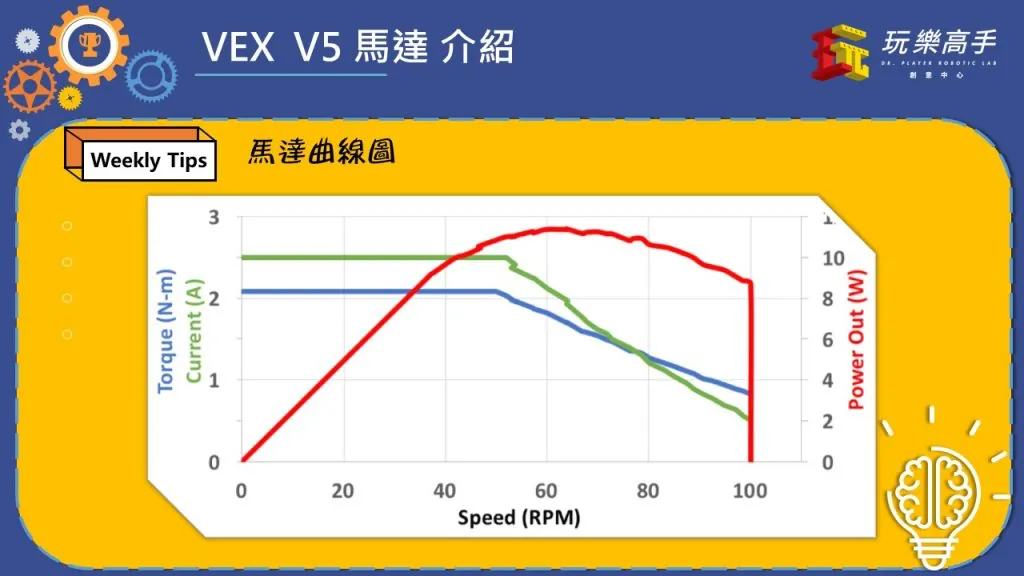
Depending on the gearbox, the motor can output 100, 200, or 600 rpm, and up to 2.1 N·m of torque. That's a very powerful motor, which lets VEX V5 be a strong robot platform at major competitions.
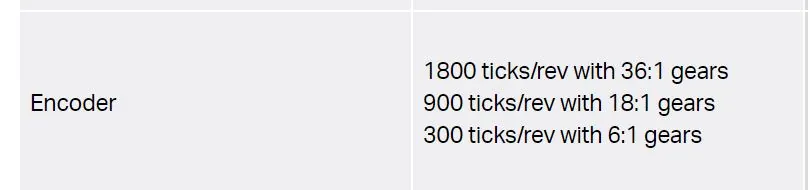
The VEX motor's encoder is also quite accurate, but because you can swap gearboxes, the encoder's precision varies with the gear ratio.
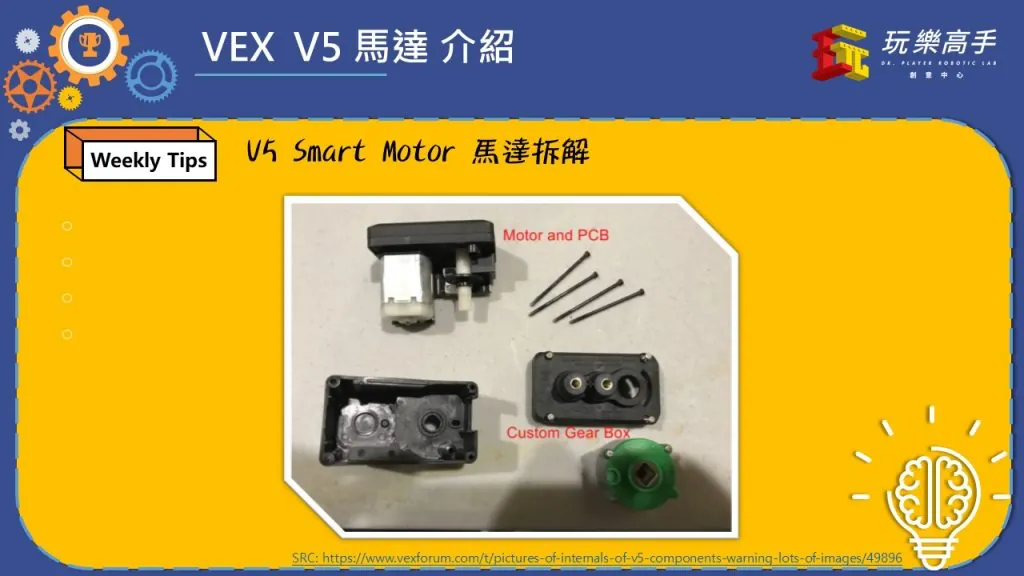
This time, let's use photos shared by overseas sites to explain the inside of the VEX V5.
Once opened, you can see the customizable gearbox in the top cover, with the main motor parts connected below.
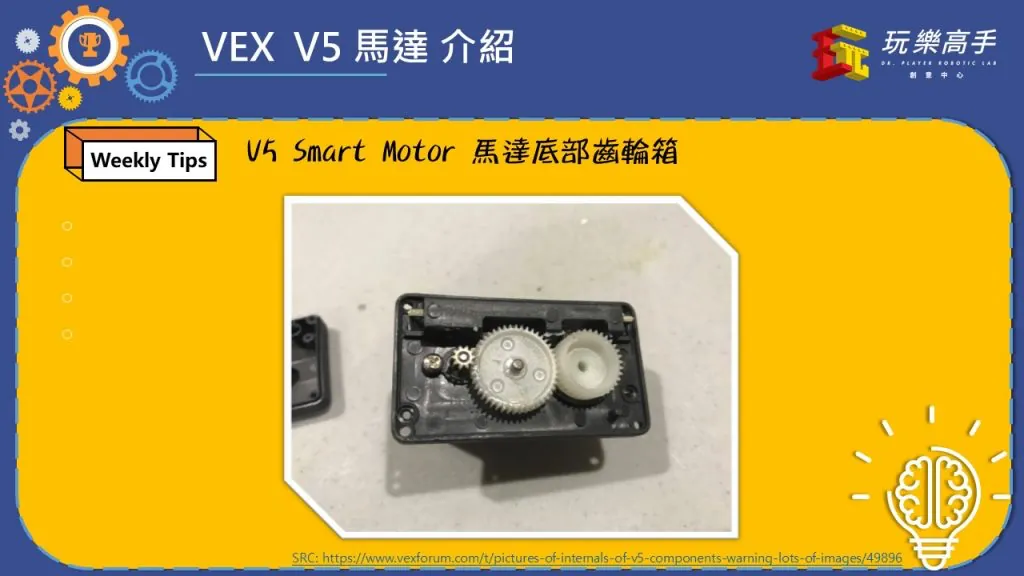
Next, the custom gear set's drive connects to the fixed gearbox below (that is, the gearbox that can't be swapped), and finally to the small 130 motor.
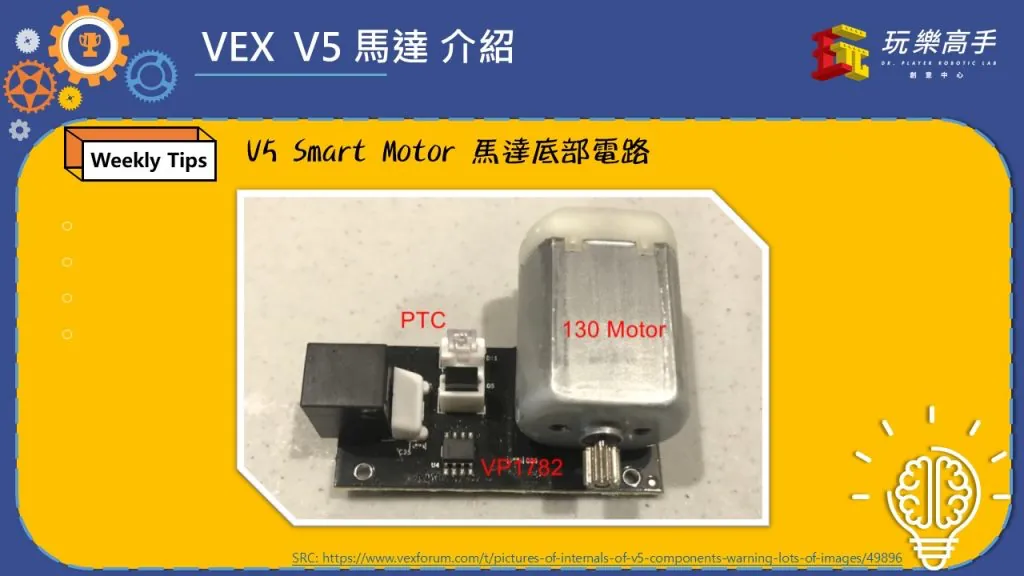
Finally, here you can see the PTC protection device and the VP1782 communication IC that talks to the Brain. Because the motor draws a lot of power, when a motor fails it is most likely that the VP1782 has burned out.
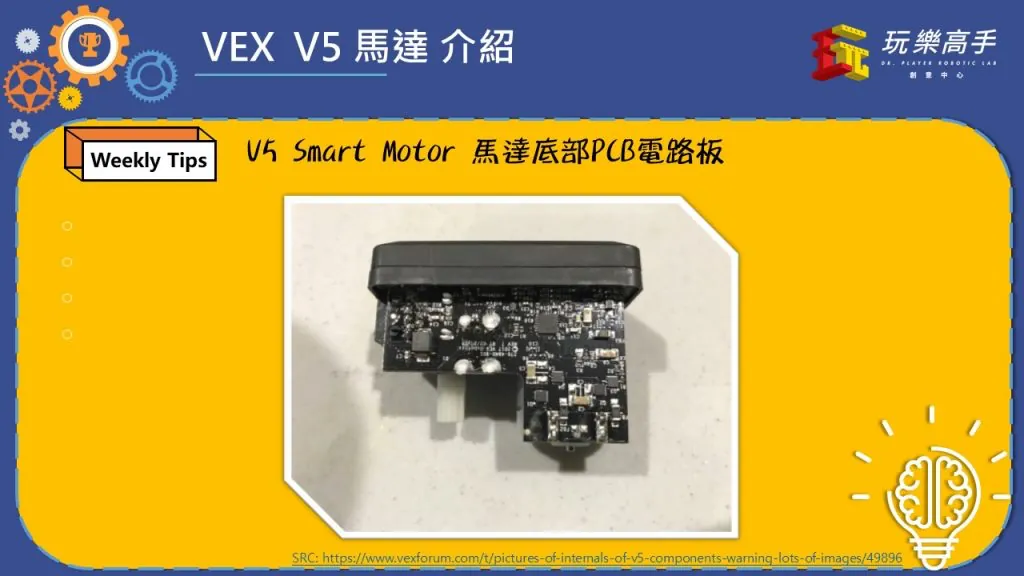
From the other side you can see that it has its own power supply and a Cortex-M0 microcontroller, so the motor's PID control is handled by the IC inside the motor. The motor IC also has temperature control, overcurrent protection, and other safeguards.
That's why you often see overseas teams blowing compressed air on their motors: overheating makes the internal IC shut the motor down. Also, a short circuit or overload may trip the PTC fuse, which takes a while to recover.