

Last week we introduced what's in the VEX V5 kit. Starting this week, we'll spend about a month looking closely at the major components of VEX V5!
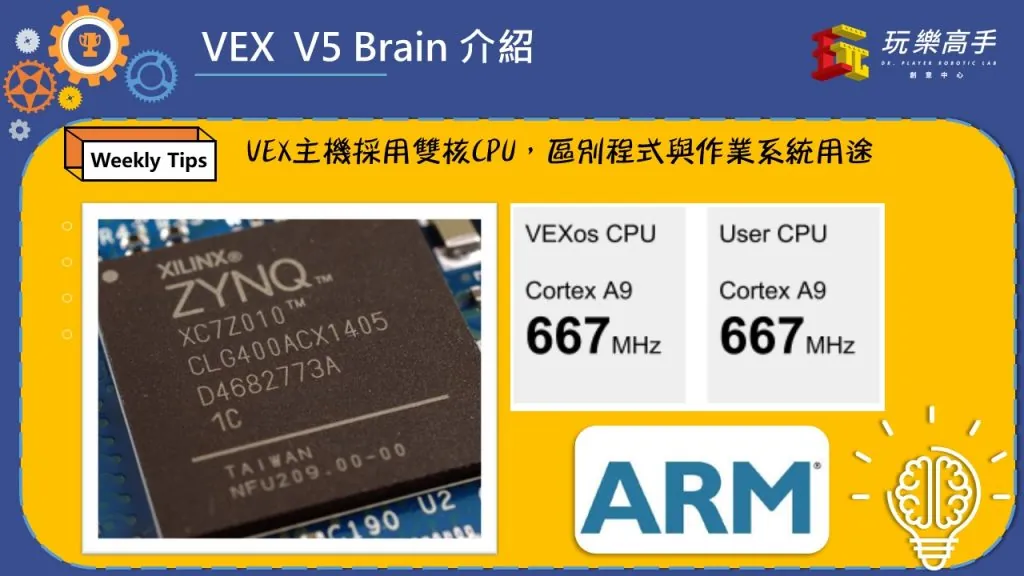
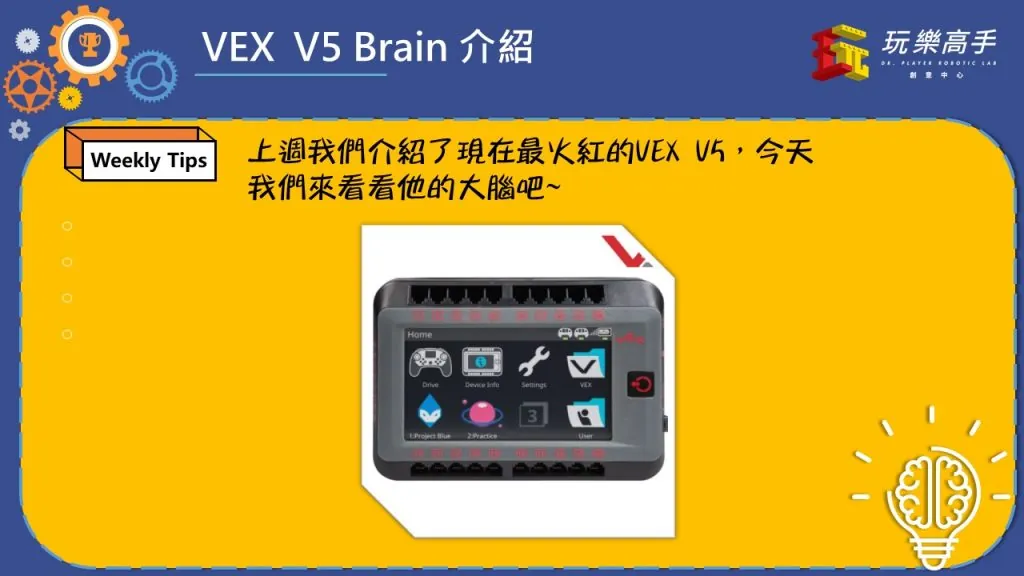
Let's start with the VEX V5 Brain. It uses an ARM® Cortex™-A9 architecture (the same CPU architecture as your phone) and a dual-core 667 MHz processor, which means your program can have a core all to itself. That helps a lot with high-speed computation!
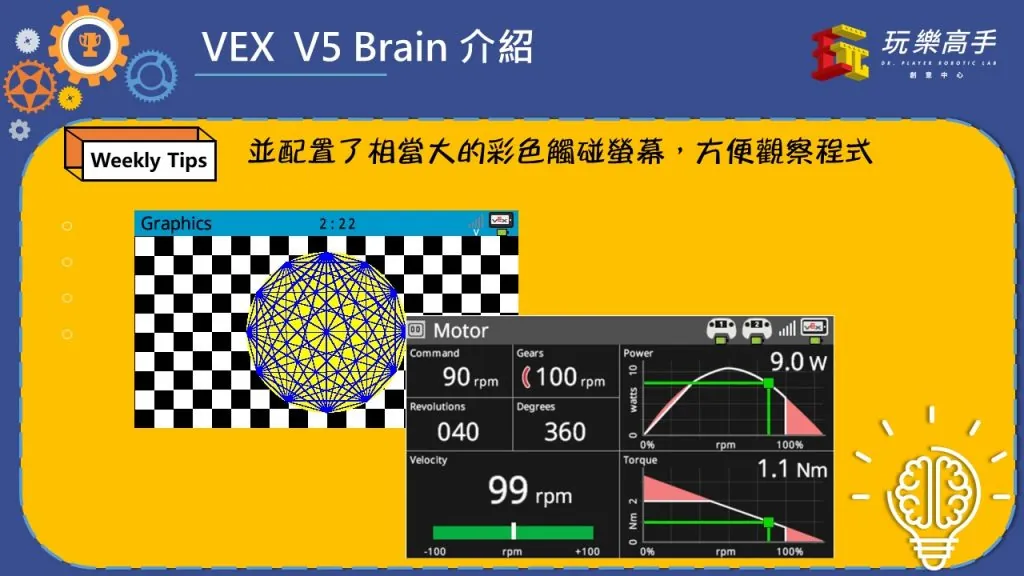
The V5 Brain also has FPGA capability, though the FPGA is mainly used to drive the screen. So the screen is very impressive too: a 4.25” TFT color touchscreen, WQVGA 480×272 pixels, far beyond other platforms in its class!!
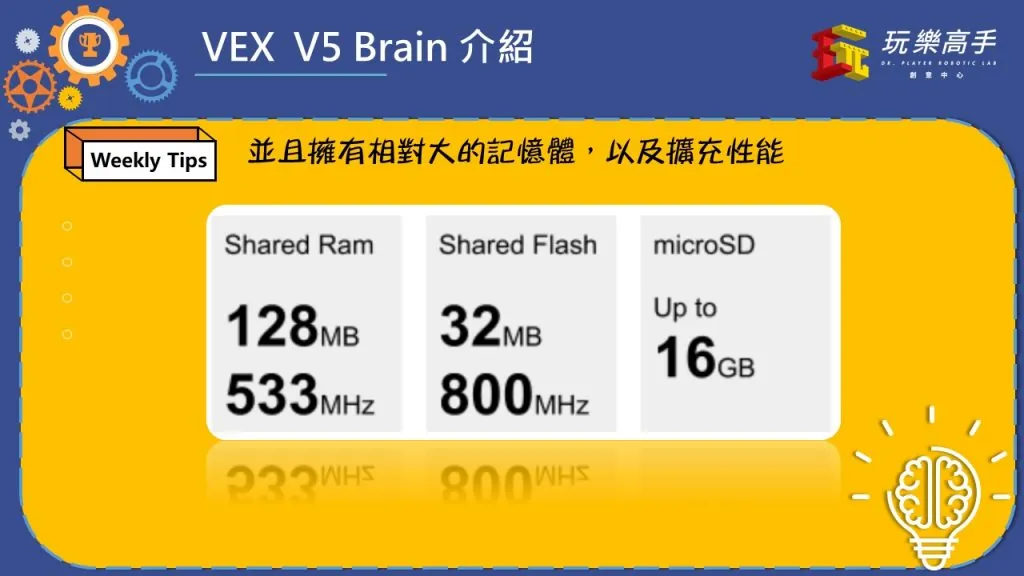
The V5 has 128 MB of RAM. That might sound small, but even the very complex programs used in competitions today won't use it all up (there may even be some left over), so you don't need to worry about running out of memory with complex programs!
It also has 32 MB of built-in flash memory for storing programs. If that's not enough, or you want to do something else (install another operating system…!?), you can add a memory card of up to 16 GB!
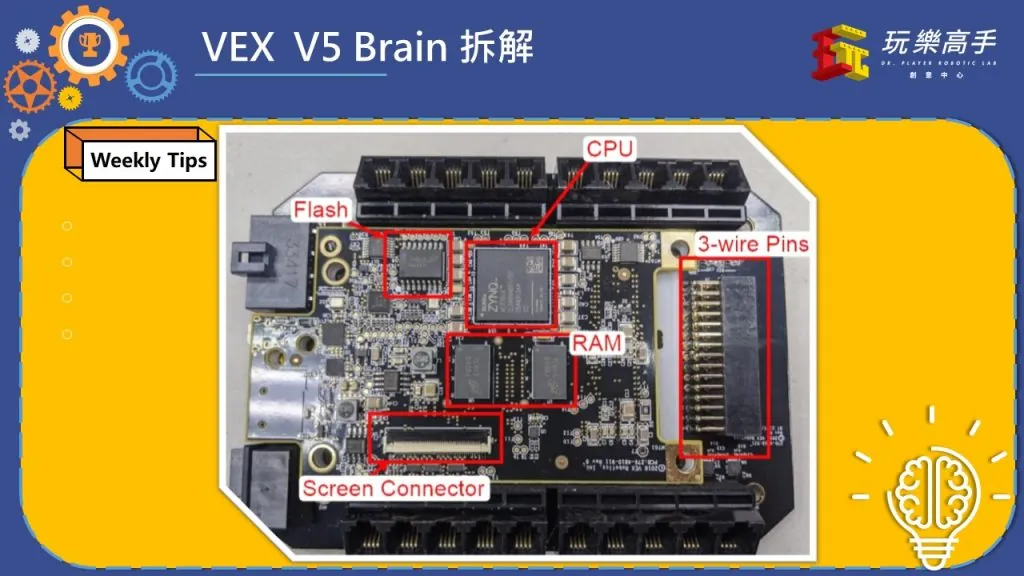
Not enough hard-core specs for you?? Come take a look! To give you a clearer picture of the V5's brain, the Dr. Player Robotic Lab team took apart a Brain to show you!
As you can see, the V5 Brain is built with solid materials and very good workmanship!
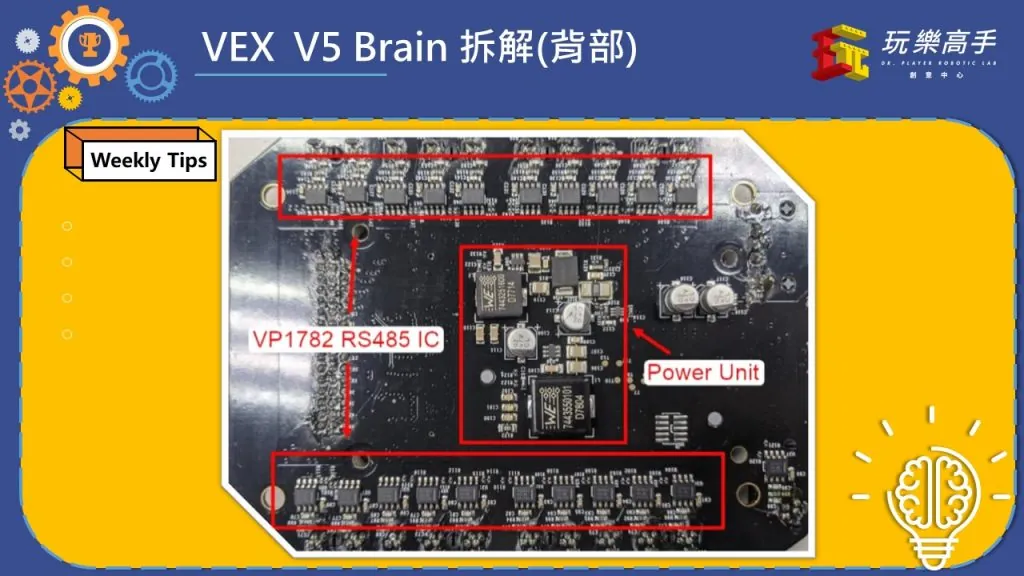
On the back of the circuit board you can see a neat row of ICs. These are TI VP1782 RS485 communication ICs, the key to the V5 Smart I/O. Every Brain port, and every sensor and motor port, has one of these ICs, building a bridge of communication between the Brain and its peripherals. Since all the bridges are the same, you don't have to keep separate input and output ports like on the LEGO EV3! (VEX IQ uses I2C, which works on a similar principle.)
Want to learn more about the V5's components? See you at next Thursday's Weekly Tips!!